


Bimonthly Membership Meeting
Wednesday, April 8, 2026
7:30 PM -- 9:30 PM
Hybrid Meeting Originating from Beechwood Farms in Pittsburgh, Pennsylvania
47 members were in attendance in-person at 3RBC's April membership meeting, held in the auditorium of Audubon Society of Western Pennsylvania's Beechwood Farms Nature Reserve. In addition to those attending in-person, 33 computers were logged on to the meeting via Zoom, with some shared by more than one person. In total, more than 80 individuals viewed the meeting, which featured Scott K. Robinson, the Katharine Ordway Professor of Ecosystem Conservation at the Florida Museum of Natural History. His presentation was titled "What do Migrant Landbirds Need When They Pass Through in Spring and Fall?"
President, Mike Fialkovich, called the meeting to order at approximately 7:30 pm. He and other club officers, directors, and members made the following announcements and reports.
- Mike Fialkovich highlighted some future opportunities for involvement of members:
- "Wings over Wilhelm," a birding festival at Goddard State Park held April 11, from 8 am to 2 pm. More information here: Wings Over Wilhelm.
- The City Nature Challenge from April 24-27, a bioblitz that uses iNaturalist to survey any organism living around the city: City Nature Challenge.
- Pennsylvania Society of Ornithology (PSO) County Spotlight in Fayette County, April 24-27 (These county spotlights are an informal meeting of birders. There will be guided walks, but you can also bird the area on your own, to contribute to PA Breeding Bird Atlas work and increase the eBird data for this area): Fayette County Spotlight.
- PSO's Annual Birding Festival, a festival being held from June 19-21, in the Altoona area, including field trips, a banquet, and speakers: PSO Overview.
- PSO's festival will include talks by two local birders, including Ezra White, who is giving a talk about his journey as a young birder, and ASWP Naturalist Nick Stahlman, who will be discussing the ASWP Certified Backyard Habitat Program. Former Pittsburgher, Ross Gallardy, will be the featured speaker and will be presenting his 2024 Pennsylvania Big Year.
- The Peregrine Editor, Bob Mulvihill, gave a preview of the next issue of the Peregrine, which will feature:
- An overview of the June meeting's speaker, Amanda Haney, and her presentation on "Birds of Trinidad and Tobago: Where Bird of Paradise Grows Wild"
- A review by of the hit YouTube documentary, Listers (viewer discretion is advised)
- Our spring Outings list
- An article by Sam Sinderson about Manitoba owl species
- A recap of the ASWP Ecotour to the Gulf Coast of Texas by Dan Mendenhall
- Tom Moeller's Observations column on bird mating rituals
We would love to have more member content to include in future issues of The Peregrine. If you have observations, photos, stories, reviews, etc., please email 3rbc.peregrine@gmail.com. - Treasurer and Webmaster, Tom Moeller, presented membership updates, suggestions, and Steve Thomas' outing list in his absence:
- Our total membership is holding steady at 339 memberships. Thank you for your contributions and continued support as members.
- To avoid costs to the club, as well as in a conservation effort, please consider opting for a digital copy of The Peregrine newsletter.
- Upcoming Outings include:
- Saturday, April 25 – Sewickley Heights Borough Park (currently filled)
- Friday, May 1 – Sewickley Heights Borough Park
- Saturday, May 2 – Boys Home Park in South Fayette Township
- Sunday, May 3 – Frick Park
- Friday, May 8 – North Park
- Saturday, May 9 – Harrison Hills Park
- Saturday, May 16 – Deer Lakes County Park
- Tuesday, May 19 – Frick Park
- Saturday, May 23 – State Game Land #330 (Piney Tract)
More details on outing locations and times, including guidelines to review before participating, can be found at: Outings page
- President Mike Fialkovich gave his overview of notable bird sightings since our last meeting. Due to Lake Erie largely freezing over this year, the area had an influx of waterfowl: American Wigeon (10), Common Goldeneye (175), Common Merganser (97), Horned Grebe (14), Redhead (60), Canvasback (92), and Long-tailed Duck. White-winged Scoter (12) at Brunot's Island and Surf Scoter along the Monongahela. Sightings of Iceland Gull and Lesser and Greater Black-backed Gull were also likely weather related. Bonaparte's Gull is moving through the area, with a high count of seventeen at Sharpsburg, so far. Great Egret, American Bittern, Common Loon, Red-throated Loon, and a Red-necked Grebe at Emsworth were additional waterbirds observed. Black Vulture continues to be reported widely. Two adults and two juvenile Red-headed Woodpeckers remain in North Park. It was noted that the Highland Park location tree, where nesting occurred last year, was not cut down. Marsh Wren, Pine Siskin, Rusty Blackbird, Orange-crowned Warbler, and the continuing of the Painted Bunting around a Squirrel Hill bird feeder were notable songbird sightings.
In addition to local sightings, Mike noted that Common Chaffinch in Montgomery County, Virginia's Warbler in Montgomery County, and a recent sighting of Western Meadowlark in Chester County were unique. - Program Director, Carol McCullough, previewed the June 3, 2026 3RBC meeting, which will be a hybrid meeting at Beechwood Farms Nature Reserve and on Zoom. It will feature speaker, Amanda Haney, and her presentation on "Birds of Trinidad and Tobago: Where Bird of Paradise Grows Wild."
Carol introduced Scott K. Robinson, an ornithologist at Florida Museum of Natural History, who studies bird ecology, behavior, and conservation. Scott's presentation was titled "What do Migrant Landbirds Need When They Pass Through in Spring and Fall?"
Having grown up in the Fox Chapel area, Scott's father, William O. Robinson, was a former President of Audubon Society of Western PA. Scott explained that he is a "birder time capsule" of the Pittsburgh area, actively birding in the mid-1970s at what we now call hotspots, like Trillium Trail. His father's favorite bird was the Blackburnian Warbler, and he remembers his father predicting, to the day, the return of Louisiana Waterthrush to the area. Scott noted that this date has now shifted from early April to late March. He now considers his father a "proto-citizen scientist," stressing the importance of the knowledge bird watchers can share through regular observation (especially with the modern contributions to data sets like eBird). Although he remembers respecting the notetaking and observation skills of older birders at the time, his father's passion for birding, took some time for him to acquire.
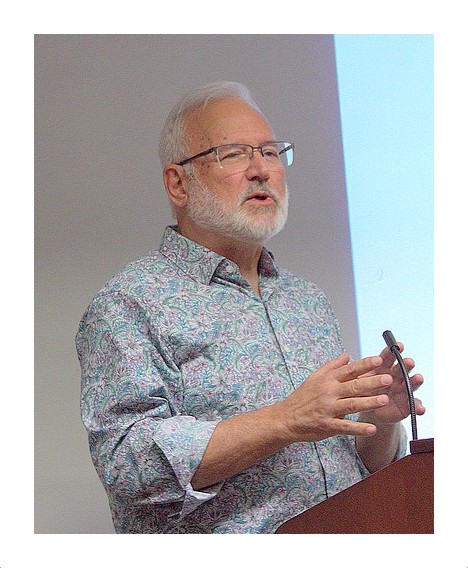
Having the perspective of birding in the 1970s, Scott noted bird population changes from then to now. He stated that at the time, common birds today, like Red-bellied Woodpecker, Turkey Vulture, Yellow-throated Warbler, Eastern Bluebird, Canada Goose, Wild Turkey, Double-crested Cormorant, Peregrine Falcon, Bald Eagle, and raptors in general, were sparse or not observed in the area. Some of this is due to range expansion, while some of these population changes are due to conservation efforts. Brown Thrasher, Eastern Towhee, Northern Flickers, and Field Sparrow were birds in an abundance. He recalls Common Nighthawks being in an abundance, swarming each of the lights at Forbes Field. Golden-winged and Blue-winged Warblers were common breeders, along with Purple Finches and some remaining Northern Bobwhites and Ruffed Grouse. He noted that the introduction of the House Finch to the East Coast likely displaced the Purple Finch in our area. In the winters large flocks of Evening Grosbeaks, Red Crossbills, Pine Grosbeaks and Redpolls, were common, with some species nesting in the area. Scott wonders what might be causing these historical changes in bird populations.
Scott explained that the Endangered Species Act, the Clean Water Act, and the outlawing of DDT have had a great impact on recovering the populations of fish-eating birds, like the Double-crested Cormorant, Osprey, and Bald Eagle. Scott suggests you read "Decline of the North American Avifauna" by Kenneth V. Rosenberg, et. al. (2019), an article widely sighted, that shows the population of birds having decreased by 3 billion individuals since the 1970s. Although fish-eating birds are in recovery, this article explains that grassland, boreal forest, and western forest bird populations have not improved. Scott explained that the population decrease is not only in endangered species, but rather, it has been observed in birds that were once very common. Red-winged Blackbird, once roosting in the millions, Rusty Blackbird, roosting at times in flocks of half a million, along with Eastern Meadowlark, Common Grackle, Brown-headed Cowbird, Field Sparrow, and Northern Flicker are some of the species whose populations have dramatically decreased. He suggests that conservation needs to focus on maintaining the abundance of common birds to maintain ecosystem balance.
Scott's research largely focuses on the population changes of migratory warblers. At one time in his birding of Trillium Trail, Scott mapped the territories of 20 Cerulean Warblers, now no longer breeding in there. Cerulean Warbler, Golden-winged Warbler, and Blackpoll Warbler populations have decreased by some of the largest percentages, as high as 90%. Black-and-white Warbler, Black-throated Blue Warbler, Canada Warbler, Prothonotary Warbler, and Nashville Warbler populations are significantly declining. What is causing this? Strangely, birds like Red-eye Vireo are increasing in population, perhaps due to their fruit-eating habits. Some of the noted reasons behind migratory bird decline are these: breeding ground loss or fragmentation, the insect apocalypse caused by insecticide use in agriculture, and habitat loss in birds wintering grounds. The challenges and dangers of migration are a largely unexplored factor, that Scott is particularly interested in researching, focusing his study in Florida.
It is believed that 70% of songbird mortality occurs during migration. Although birds are quite skilled at adapting to different stopover spots with varying habitat quality, how they deal with fragmentation and human-caused changes is an area for research. New technologies, like MOTUS, satellite tracking, and BirdCast, are giving researchers a better understanding of how birds move and where they are during migration. Isotope studies are giving researchers insight into what birds are eating along the way. In addition to ornithological work, Scott stresses the importance of citizen science in expanding our knowledge of migration patterns. Christmas Bird Counts, Bird Censuses and Surveys, daily eBird data, and iNaturalist all contribute to our current knowledge of bird populations, as well as the availability of their resources, such as plants and insects.
Scott explains that caterpillars and insects are a major nutritional source for migrating warblers in spring migration. They time their migration to coincide with the peak emergence of caterpillar species, riding the "caterpillar wave" northward to their breeding grounds. Even grassland birds, like Prairie Warbler, are observed foraging in the high canopies of trees during this time. Emerging foliage along with flooded wetlands are areas where caterpillar and insect populations are abundant. Incredibly social, mixed flocks of species are common in the spring as many species seem to help each other find food. Some species, like Magnolia Warbler and American Redstart, have evolved a flush-chase behavior, flicking their tail spots, to startle insects, and flycatching them after. Caterpillars, insects, and spiders are an important food source throughout breeding season. In the fall migrating songbirds do not need to time their flight southward for insects and many switch to fruit as a fuel source.
During migration songbirds use different habitats as stopover or refueling spots. Stopover spots are areas where they are spending a longer time (7-10 days), resting, eating enough to create fat stores, and recovering muscle loss. These spots are usually larger tracts of land. Habitats like swamps, wetlands, and grasslands have experienced the largest decline in total area due to urban sprawl and agricultural practices. This may be contributing to the decrease in species like Prothonotary Warbler, Bay-breasted Warbler, Bobolinks, swallows, Orchard Oriole, and grasspipers (certain shorebirds). Refueling spots are areas where birds quickly acquire food sources to continue their migration. Refueling spots can occur anywhere along a bird's route, and Scott notes that research suggests that birds do not avoid urban areas when selecting where to find quick resources. He believes that migrating warblers that have a fruit-centered diet, like Tennessee Warbler, or birds like Ovenbird, that depend on insect populations that are doing well, like ants, may have more stable populations due to finding these resources in refueling spots. Strict insectivores seem to be struggling to find resources in refueling and stopover spots. Window strikes, light pollution, and predation by cats are known ecological traps that need to be addressed in our problem solving effort.
Scott explained that large-scale improvement of stopover spots through habitat restoration and changes in farming practices could have a great impact on recovering bird populations, but we can individually have the most impact in improving refueling spots for migrating birds. If everyone were to improve the caterpillar and insect populations in their own yard, along with fruit abundance, migrating birds would benefit greatly from these resources. Scott suggested oaks as a great species to plant in your yard. Oaks host one of the largest varieties of insects of any species of plant. Sweetgum, Hackberry, willow varieties, Sugarberry, Box Elder, and Sycamores have been shown to be great sources of food for birds. Some of the evidence of the effectiveness of these plants has been discovered through citizen science, which in turn has influenced habitat restoration practices. In addition, reducing ecological traps and providing birds with resources like clean water are important. Scott suggested that along with improving your backyard habitat, documenting what birds are eating through photography or notetaking in eBird could greatly contribute to ornithological knowledge in the future, especially with advances in AI photo recognition. He explained that increasing the number of people involved in citizen science along with supporting the next generation of birders and naturalists will amplify our abilities to document what birds need during migration.
Scott took questions from the audience and online viewers. Qualitatively, people in the crowd agreed that they have seen a massive decrease in insect populations in the last 50 years and wonder if this correlates with decreases in bird populations.
After questions, President Fialkovich thanked Scott for his presentation and adjourned the meeting.
— prepared by Dan Mendenhall on April 17, 2026


